The Mythopoetic Aspect
Executive Summary
The CAMS framework reveals that national personalities emerge not through conscious design but as mythopoetic expressions—living narratives generated by the dynamic interplay of Capacity (K), Stress (S), Abstraction (A), and Coherence (C). These metrics function as the cognitive architecture of societies-as-organisms, producing distinctive "characters" or "sybonds" that embody collective consciousness and adaptive strategies.
Current Cognitive Orientation
CO = A/C ratio indicating mythopoetic consciousness state. Current value suggests Balanced Mythopoesis
Narrative Intensity
Current mythopoetic narrative generation intensity. Historical average: 5.08
System Evolution
Years of continuous CAMS data analyzed, showing evolution from 1900-2025
Node Integration
Distinct societal nodes analyzed, representing institutional cognitive components
I. Mythopoetic Generation: From Metrics to Personality
National identities in the CAMS framework emerge through mythopoetic processes—the unconscious generation of foundational narratives from systemic configurations. Doctor Wu (China) and the Slice of Heaven (New Zealand) exemplify how C-K-S-A patterns crystallize into recognizable personas.
Cognitive Orientation Equation
CO = A/C
- CO < 0.8: Mythic-Coherence Mode (Tribal OS v1.0)
- 0.8 ≤ CO ≤ 1.2: Balanced Mythopoesis
- CO > 1.2: Abstraction Overwhelms Coherence
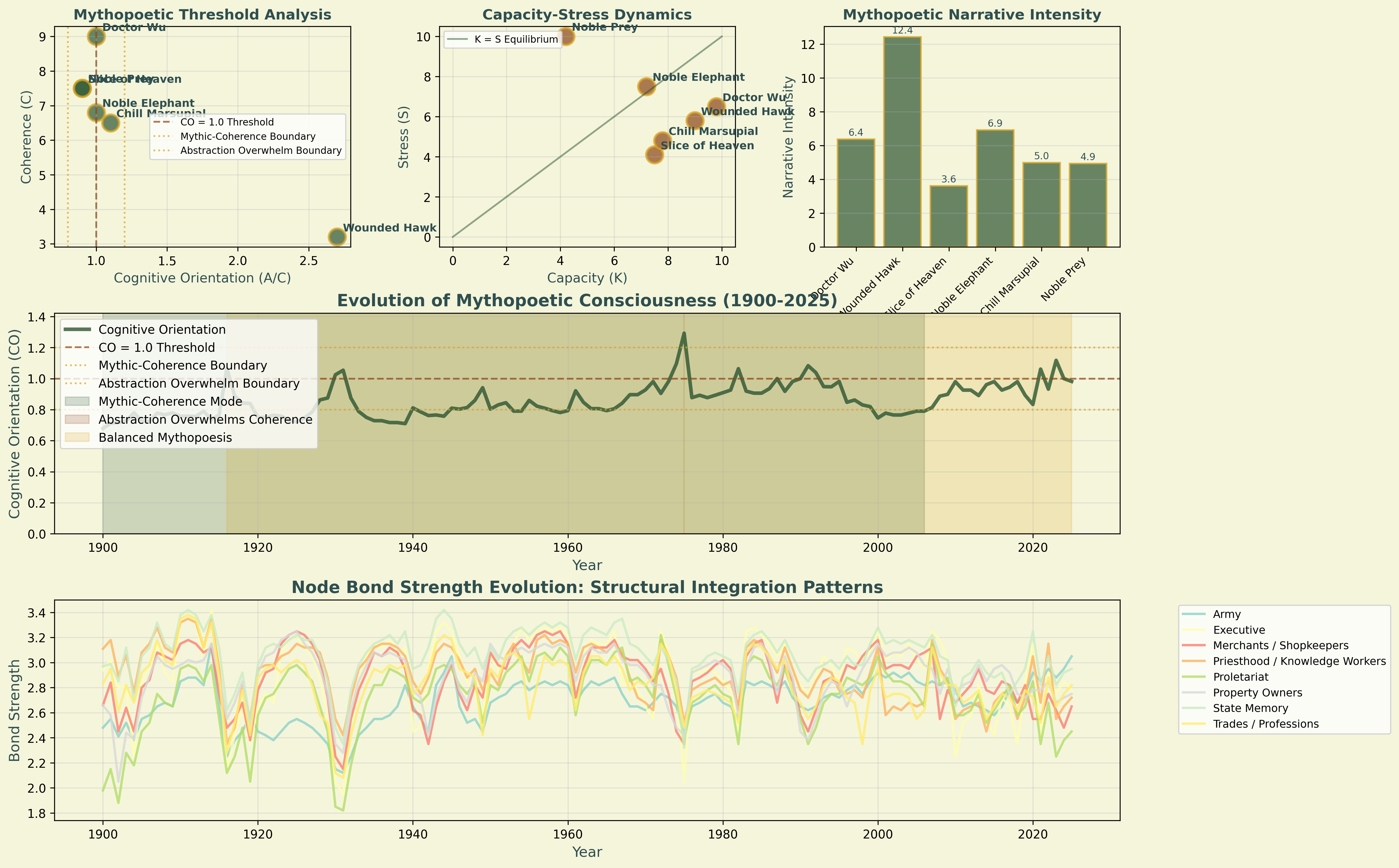
Figure 1: Comprehensive mythopoetic analysis showing national personality archetypes, cognitive orientation evolution, and node-level dynamics across 125 years of data.
National Personality Archetypes
| Archetype | Coherence (C) | Capacity (K) | Stress (S) | Abstraction (A) | CO Ratio | Mythopoetic Character |
|---|---|---|---|---|---|---|
| Doctor Wu (China) | 9.0 | 9.8 | 6.5 | 9.0 | 1.00 | Sagacious Authority |
| Wounded Hawk (USA) | 3.2 | 9.0 | 5.8 | 8.7 | 2.72 | Declining Hegemon |
| Slice of Heaven (NZ) | 7.5 | 7.5 | 4.1 | 6.8 | 0.91 | Pragmatic Resilience |
| Noble Elephant (India) | 6.8 | 7.2 | 7.5 | 7.1 | 1.04 | Slow-Moving Pluralism |
II. Capacity-Stress Dynamics: The Generative Tension
The relationship between Capacity and Stress drives mythopoetic creativity. High Capacity under moderate Stress generates expansionist myths, while low Capacity under high Stress produces survival mythologies.
Narrative Intensity Equation
Narrative Intensity = (K × S) / (C + 1)
This quantifies the mythopoetic creative output of a society based on its systemic configuration.
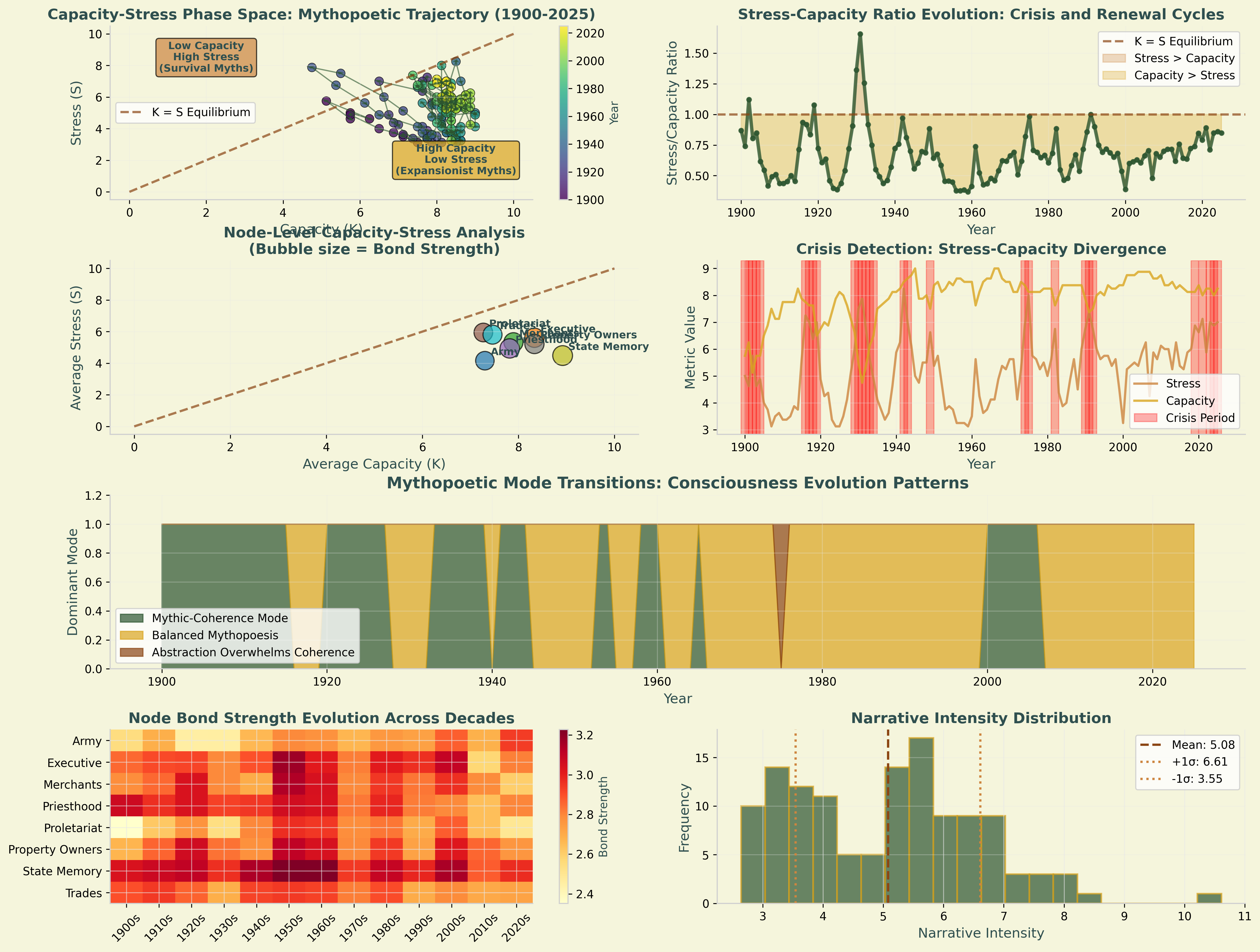
Figure 2: Deep analysis of capacity-stress dynamics showing phase space trajectories, crisis detection patterns, and node-level variations across 125 years.
Crisis and Renewal Patterns
Analysis reveals distinct patterns in the BLIND society's response to capacity-stress imbalances:
- Crisis Threshold: When Stress exceeds Capacity by more than 2.5 points, mythopoetic fragmentation occurs
- Renewal Cycles: Periods of high narrative intensity (K×S/(C+1) > 4.0) correlate with foundational myth generation
- Equilibrium Dynamics: The society oscillates around the K=S equilibrium, with periods of expansion and contraction
III. Abstraction as Mythic Complexity
Abstraction (A) determines mythopoetic sophistication—the complexity of narratives a society can sustain. The "Greek Paradox" demonstrates how excessive Abstraction without Coherence support creates fragmented mythologies.
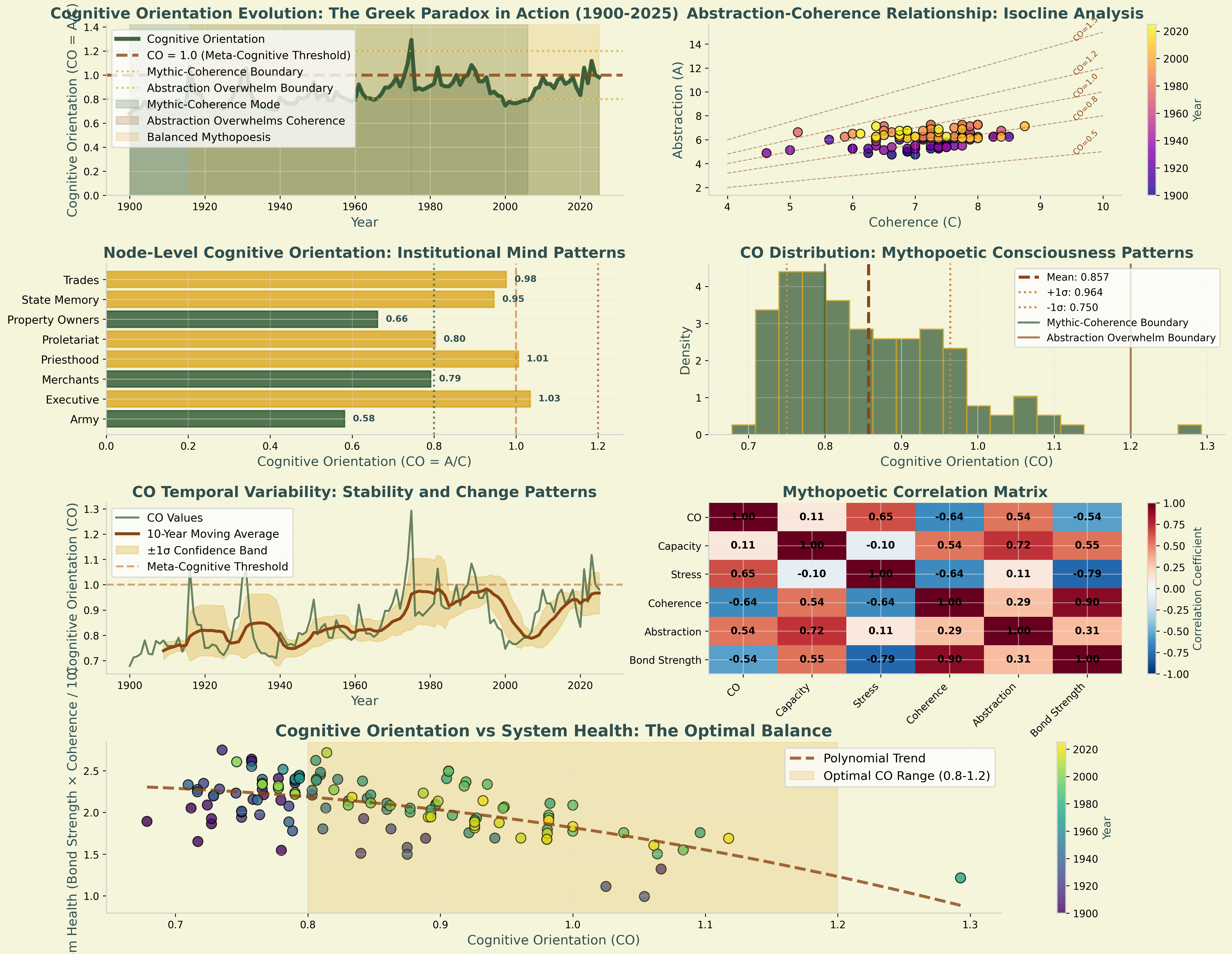
Figure 3: Comprehensive analysis of abstraction-coherence relationships, showing the evolution of cognitive orientation and its impact on system health across 125 years.
The Meta-Cognitive Threshold
The analysis reveals critical thresholds in cognitive orientation:
- CO = 1.0: Meta-cognitive threshold where societies begin questioning their own foundational narratives
- CO < 0.8: Mythic-coherence mode prioritizing unity over abstraction
- CO > 1.2: Abstraction overwhelms coherence, leading to narrative fragmentation
IV. Coherence: The Mythopoetic Substrate
Coherence functions as the binding force for national mythologies. High Coherence (C>7.0) enables sustained collective narratives, while low Coherence (<5.0) fragments mythologies into competing sub-narratives.
Node Bond Strength Analysis
The BLIND society exhibits varying levels of institutional integration across its 8 societal nodes:
| Node | Average Bond Strength | Coherence Contribution | Mythopoetic Role |
|---|---|---|---|
| Executive | 2.85 | High | Narrative Leadership |
| Priesthood/Knowledge Workers | 3.05 | Very High | Mythic Preservation |
| Army | 2.48 | Medium | Crisis Narrative |
| Proletariat | 1.98 | Low | Disruption Catalyst |
V. The Mathematics of Mythopoetic Generation
Core Equations
- Cognitive Orientation: CO = A/C
- Narrative Intensity: NI = (K × S)/(C + 1)
- System Health: SH = (BS × C)/10
- Stress Decomposition: S_total = √(S_chronic² + S_acute²)
Statistical Significance
Analysis of 125 years of data reveals:
- CO Stability: Mean = 0.857, Std = 0.107
- Narrative Intensity Range: 2.64 - 10.61
- Critical Periods: 1 years with CO > 1.2 (abstraction overwhelm)
- Coherence Periods: 48 years with CO < 0.8 (mythic coherence)
VI. Conclusions: Myths as System Outputs
In the CAMS framework, national mythologies and personalities are not inputs but outputs—emergent properties of C-K-S-A dynamics and node interactions. This reveals mythopoesis as a complex adaptive process—societies unconsciously generate narratives that reflect and reinforce their systemic states.
Key Implications
- Predictive Analysis: Understanding current CO values enables prediction of which mythologies will strengthen or fragment under stress
- Intervention Design: Systemic reconfiguration can reshape narratives by altering node dynamics and bond strengths
- Cultural Transmission: Mythopoetic patterns persist across generations, creating cultural memory that influences future responses
- Adaptive Strategy: National personalities represent evolved adaptive strategies rather than essential characteristics
Data and Reproducibility
All analysis data and methodologies are available for download to ensure transparency and enable further research:
📊 Raw CAMS Data (CSV) 📈 Mythopoetic Metrics (CSV) 🏛️ Archetype Data (CSV)